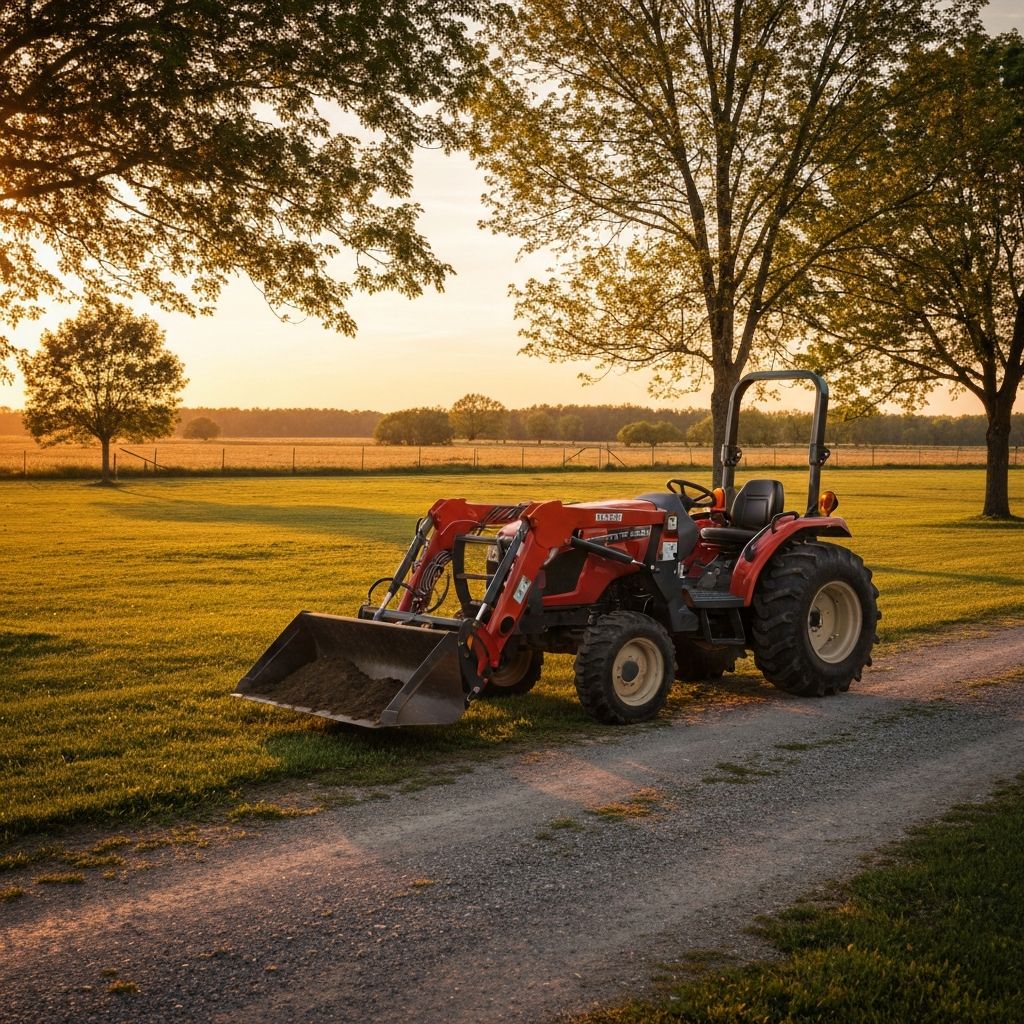
Compact Tractor Buyer’s Guide (2026): How to Choose the Right 25–50 HP Tractor
Last Updated: February 2026
Last Updated: February 2026
A compact tractor is a mid-frame utility machine in the 25–50 engine horsepower class, built for property owners managing 5 to 20+ acres. Compact tractors are the workhorse class—powerful enough for serious brush cutting, grading, post-hole drilling, light hay operations, and backhoe work, yet small enough for a single operator on a homestead or small farm.
If you’re stepping up from a sub-compact or buying your first serious tractor, the compact class offers the best balance of capability, versatility, and value. This guide covers every spec, decision, and pitfall you need to navigate—including downloadable checklists, sortable comparison tables, cost-per-hour modeling, and an interactive setup picker.
Built by the Tractor Iron editorial team. For task-specific recommendations, see our Tractors by Task guide, our Best Tractors for Mowing page, or our Tractor Attachment Guide.
Follow these seven steps to narrow your choices before visiting a single dealer.
List your top 3-5 tasks
Mowing, loader work, grading, tilling, snow removal, post-hole drilling, hay? Your primary tasks dictate every spec decision.
Confirm compact is the right size class
If you manage 5-20+ acres with moderate-to-heavy tasks, a compact (25-50 hp) is the sweet spot. Under 5 acres with light tasks? Sub-compact may suffice. Over 50 acres of constant heavy work? Consider utility class.
Match PTO HP to your heaviest implement
Your heaviest PTO-driven implement (rotary cutter, tiller, disc mower, baler) sets your minimum PTO horsepower floor. Add a 15% safety margin.
Set loader capacity and hydraulic flow targets
Target minimum lift capacity at both pivot pins and 500 mm forward. Check hydraulic flow in GPM—critical for loader responsiveness and running multiple circuits.
Choose transmission: HST vs gear vs power shuttle
HST for loader-heavy and mixed use. Gear or power shuttle for sustained PTO work like tilling and hay.
Choose attachments in priority order
Loader first, then box blade, pallet forks, rotary cutter. Add specialized implements based on your task list.
Compare 2-3 models with our checklist and table
Use the dealer checklist below to walk into a dealership prepared. Use our sortable table and compare mode to evaluate models head-to-head.
Pro Tip
Start with your heaviest implement, not the tractor. If your heaviest PTO job needs 30 hp, you need at least 35 engine HP. Build from the implement up—not the tractor down.
Safety Warning
Always wear your seatbelt with the ROPS (roll-over protective structure) in the upright, locked position. Never fold the ROPS down on slopes. Compact tractors are heavier than sub-compacts but rollover risk is still real, especially on hills with a raised loader.
Use this chart as a starting point. Actual HP needs depend on terrain, soil, and task intensity.
Slope adjustment: Add 5–10 HP for hilly terrain, heavy clay, or rocky soil. Slopes demand more power and traction than flat ground at the same acreage.
Understanding where compact tractors sit in the lineup helps you avoid buying too small or too large.
Dealer brochures list dozens of specs. These are the ones that determine whether a compact tractor will handle your work.
Engine HP is measured at the flywheel. PTO HP is what reaches your implements after drivetrain losses (typically 15–20% less). PTO HP determines what implements you can run.
| Engine HP | Typical PTO HP | Implements Supported |
|---|---|---|
| 25-30 | 20-24 | 5' rotary cutter, 48" tiller, snowblower |
| 31-40 | 24-32 | 6' rotary cutter, 60" tiller, disc mower |
| 41-50 | 32-40 | 7' cutter, 72" tiller, small round baler |
Hydraulic flow in gallons per minute determines how fast your loader, steering, and auxiliary circuits operate. Higher GPM = more responsive loader and ability to run hydraulic-intensive attachments.
| GPM Range | Capability |
|---|---|
| 6-10 GPM | Basic loader, standard steering |
| 10-14 GPM | Responsive loader, single remote circuit |
| 14-18+ GPM | Fast loader, multiple remotes, backhoe-ready |
Measured at the pivot pins (higher number, marketing-friendly) and at 500 mm forward (realistic working capacity). Always compare 500 mm forward numbers when shopping.
Typical compact: 1,200–2,500 lbs at pivot pins, 800–1,500 lbs at 500 mm forward.
Heavier tractors are more stable with a loaded loader and resist tipping better on slopes. A longer wheelbase improves stability. Compact tractors typically weigh 2,500–5,500 lbs.
Heavier is generally better for loader work, but increases turf compaction.
Most compacts use Category 1 hitch, with upper models (40-50 hp) offering Cat 1/2. Rear lift capacity (1,000–2,500+ lbs) determines how heavy an implement you can carry. Ensure it exceeds your heaviest rear implement by at least 20%.
Tighter turning radius matters in orchards, around buildings, and on tight properties. Typical compact turning radius: 7–12 feet.
Fuel consumption: 1.0–2.5 GPH depending on HP and load. Tier 4 engines are more fuel-efficient but require DEF or DPF systems on some models.
4WD is effectively mandatory for compact tractors. It provides critical traction for loader work, grading, slopes, and wet conditions. Nearly all modern compacts include 4WD with differential lock for maximum traction when one tire slips.
Common Mistake
Comparing engine HP instead of PTO HP. Two tractors with 35 engine HP can have different PTO HP due to drivetrain losses. Always ask: "What is the rated PTO horsepower?" That is the number that determines implement capability.
Compact tractors offer more transmission options than sub-compacts. Choosing the right one depends on your primary tasks.
| Aspect | HST | Gear | Power Shuttle |
|---|---|---|---|
| Best for | Loader / mowing / snow | Tilling / steady PTO | Mixed / moderate loader |
| Ease of use | Easiest | Most demanding | Moderate |
| PTO efficiency | Lower | Highest | Good |
| Loader suitability | Excellent | Poor | Good |
| Price impact | Highest | Lowest | Mid-range |
Your property’s layout and terrain determine critical equipment choices.
Add 5–10 HP to your baseline for slopes. Heavier tractors with longer wheelbases handle grades better. 4WD and differential lock are mandatory. Keep the loader low when driving on inclines. Rear ballast is critical—never operate on slopes without it.
Compact tractors with loaders are typically 56–72 inches wide overall. Measure every gate, barn door, and trail opening before purchasing. Some loaders can be removed for tight-access areas, but that adds setup time.
Hard and rocky soil increases PTO HP demand for tilling and post-hole drilling. Size up 5–10 HP from what you’d need in soft soil. R4 industrial tires handle rocky ground better than turf tires.
In wet conditions, traction is paramount. 4WD with differential lock, R4 or R1 tires, and adequate weight distribution prevent getting stuck. Consider loaded tires for permanent additional weight in mud-prone areas.
The right attachments multiply your compact tractor’s value. Match every implement to your tractor’s PTO HP, hitch category, and hydraulic capacity.
For a complete guide, see our Tractor Attachment Guide and Loader Attachments Guide.
SSQA quick-attach recommended. Check lift capacity at 500 mm forward.
Scarifier teeth essential for driveway work. Match width to tractor.
Highest ROI attachment. Moving materials, hay bales, firewood, landscape supplies.
For brush and thick grass. Match PTO HP carefully.
For garden prep and food plots. Hard soil needs higher PTO.
9-12" auger for fence posts. Heavy duty for rocky soil.
PTO-driven. More effective than blade in deep snow.
For hay production. Requires upper compact range.
Check compatibility with your model. Needs 35+ hp and 12+ GPM.
Attachment Budget Rule
Budget 50–100% of the tractor’s purchase price for implements. A $25,000 compact tractor will typically need $12,000–$25,000 in attachments for a full working setup. Buy quality—cheap implements wear fast and cost more over time.
The front-end loader is the most-used attachment on any compact tractor. Choose carefully.
For detailed loader specs and options, see our Loader Attachments Guide.
| Spec | 25-35 HP Compact | 35-50 HP Compact |
|---|---|---|
| Lift at Pivot Pins | 1,200–1,800 lbs | 1,800–2,500 lbs |
| Lift at 500 mm Forward | 800–1,200 lbs | 1,200–1,500 lbs |
| Max Lift Height | 80–95" | 90–110" |
| Digging Depth | 4–6" | 5–7" |
| SSQA Quick-Attach | Recommended | Standard on most |
Third-Function Hydraulics
If you plan to use a grapple, log splitter, or other hydraulic loader attachments, you need a third-function hydraulic kit. Order it at purchase time—retrofitting is expensive. This adds a third hydraulic circuit to your loader for running auxiliary attachments.
Understanding total ownership cost helps you budget realistically and compare value across models.
| HP Range | Fuel (GPH) | Est. Fuel Cost/hr | Maintenance Tier | Typical Cost/hr |
|---|---|---|---|---|
| 25-30 HP | 1.0-1.5 | $4-$6 | Low | $8-$12 |
| 31-40 HP | 1.5-2.0 | $6-$8 | Medium | $10-$14 |
| 41-50 HP | 2.0-2.5 | $8-$10 | Medium-High | $12-$16 |
Fuel cost based on ~$4/gallon diesel. Ownership cost includes estimated depreciation, maintenance, and fuel. Actual costs vary by usage intensity and brand.
Higher HP compact tractors are often more fuel-efficient per HP-hour than lower HP models. A 45 hp tractor running at 60% load uses less fuel per unit of work than a 30 hp tractor running at 90% load.
Tier 4 Final engines meet stricter emissions standards and are generally more fuel-efficient. Some require DEF (diesel exhaust fluid) or use DPF (diesel particulate filter) regeneration. Factor DEF cost (~$10/gallon) into operating costs if applicable.
Follow this hour-based schedule to maximize tractor life and minimize downtime.
| Interval | Tasks |
|---|---|
| 10 hr | Grease all fittings, check tire pressure, inspect coolant level, check engine oil level |
| 50 hr (break-in) | First oil and filter change, check/tighten all bolts, inspect front axle fluid, replace any debris-clogged filters, check hydraulic fluid level |
| 200 hr | Engine oil and filter change, inspect air filter, check belt tension, lubricate all pivot points, inspect battery terminals |
| 400-600 hr | Hydraulic filter change, fuel filter change, coolant system inspection, transmission fluid check, inspect PTO clutch, valve adjustment check |
| 1000-2000 hr | Full fluid flush (engine, hydraulic, transmission, coolant), inspect injectors, check front axle bearings, replace air filter, inspect brakes, consider professional dealer service |
50-Hour Break-In Warning
The first 50-hour service is critical. New tractors shed metal debris into oil, filters may clog with factory residue, front axle fluid may be low, bolts loosen from vibration, and grease zerks need initial attention. Do NOT skip or delay the 50-hour service. Have fluid spill prep ready.
Every one of these mistakes costs real money. Learn from others’ experiences.
Wrong dealer
Choosing a brand based on price without considering the nearest dealer. A dealer 100 miles away means expensive downtime. Always prioritize local dealer strength.
Wrong size tractor
Buying a sub-compact when you need a compact, or a compact when a utility would save time and wear. Match HP to your heaviest implement and acreage, not your lightest task.
Wrong attachment matching
Buying implements that exceed your PTO hp or hitch category. A 7-foot tiller on a 30 hp tractor will stall, overheat, and damage both the tractor and implement.
Ignoring parts access
Some brands have limited parts availability in certain regions. Ask the dealer: Can you get common wear parts (filters, belts, blades) within 48 hours?
Skipping warranty details
Not all warranties are equal. Compare powertrain years, hour limits, and what is excluded. A 6-year powertrain warranty is far more valuable than a 2-year bumper-to-bumper.
Under-ballasting
Operating a loader without rear ballast is dangerous. A 3,000 lb compact lifting 1,500 lbs at the front without counterweight will tip. Budget for a ballast box or loaded tires at purchase time.
Ignoring width constraints
Compact tractors with loaders can be 60-72 inches wide. Measure every gate, barn door, and trail opening before purchasing. A tractor you cannot fit through your gate is useless for half your property.
A strong dealer network reduces downtime. The best tractor specs in the world are worthless if parts and service are 100 miles away.
Scores are derived from real owner data in our database. Find your nearest dealer on our Dealer Directory page.
Print this checklist and bring it to the dealership. It ensures you ask the right questions and record the answers for every model you evaluate.
All compact-class models from our database. Sortable, filterable, and exportable. Select up to 3 models to compare side-by-side.
| Compare | ||||||||||||
|---|---|---|---|---|---|---|---|---|---|---|---|---|
| Bobcat CT2025 | 24.5 | 21.8 | Hydrostatic | 11.34 | 1,631 lbs | 2,646 | N/A | $16,507 | N/A | N/A | N/A | |
| Bobcat CT2035 | 34.9 | 29.4 | Hydrostatic | 11.34 | 1,631 lbs | N/A | N/A | $21,044 | N/A | N/A | N/A | |
| Bobcat CT2535 | 34.9 | 29.4 | Hydrostatic | 11.7 | 1,631 lbs | 3,397 | N/A | $33,268 | N/A | N/A | N/A | |
| Bobcat CT4045 | 44.9 | 32.8 | Hydrostatic | 14.5 | 2,716 lbs | 3,448 | N/A | $25,795 | N/A | N/A | N/A | |
| Bobcat CT4545 | 44.9 | 32.8 | Hydrostatic | 14.5 | 2,716 lbs | 4,300 | N/A | $49,047 | N/A | N/A | N/A | |
| Bobcat CT4558 | 57.7 | 45.1 | Hydrostatic | 14.5 | 2,716 lbs | 4,300 | N/A | $53,834 | N/A | N/A | N/A | |
| Case IH Farmall 30C | 32.2 | 26 | Hydrostatic | 7.3 | 1,433 lbs | 3,218 | N/A | $25,905 | N/A | N/A | N/A | |
| Case IH Farmall 35A | 35 | 29.7 | Hydrostatic | 8.2 | 1,433 lbs | 3,067 | N/A | $29,903 | N/A | N/A | N/A | |
| Case IH Farmall 35C | 36.2 | 29.6 | Hydrostatic | 7.3 | 1,433 lbs | 3,218 | N/A | $27,929 | N/A | N/A | N/A | |
| Case IH Farmall 40A | 40 | 34 | Hydrostatic | 8.2 | 1,433 lbs | 3,067 | N/A | $32,133 | N/A | N/A | N/A | |
| Case IH Farmall 45A | 45 | 39 | Synchro Shuttle | 11.6 | 1,830 lbs | 3,836 | N/A | $28,080 | N/A | N/A | N/A | |
| Case IH Farmall 50A | 50 | 46 | Synchro Shuttle | 11.9 | 2,701 lbs | 5,060 | N/A | $30,240 | N/A | N/A | N/A | |
| John Deere 2025R | 23.9 | 18.2 | Hydrostatic | N/A | 915 lbs | 1,872 | 8.7 ft | $23,200 | 4 yr | 9/5 | 8.7/5 | |
| John Deere 2032R | 30.7 | 24.2 | Hydrostatic | N/A | 1,356 lbs | 2,879 | 9 ft | $29,200 | 4 yr | 9.1/5 | 8.7/5 | |
| John Deere 2038R | 36.7 | 28.5 | Hydrostatic | N/A | N/A | N/A | 9 ft | $33,100 | 4 yr | 9.1/5 | 8.8/5 | |
| John Deere 3025E | 24.7 | 18.2 | Hydrostatic | N/A | 1,356 lbs | 2,222 | 8.9 ft | $21,800 | 4 yr | 8.7/5 | 8.4/5 | |
| John Deere 3032E | 31.2 | 25 | Hydrostatic | N/A | 1,356 lbs | 2,222 | 9 ft | $26,700 | 4 yr | 9/5 | 8.7/5 | |
| John Deere 3033R | 31.8 | 23 | Hydrostatic | N/A | 2,194 lbs | 2,983 | 14.1 ft | $32,000 | 4 yr | 8.6/5 | 8.4/5 | |
| John Deere 3038E | 36.7 | 30 | Hydrostatic | 5.3 | 1,356 lbs | 2,668 | 9 ft | $30,800 | 4 yr | 9/5 | 8.8/5 | |
| John Deere 3046R | 44.7 | 33.9 | Hydrostatic | N/A | 2,194 lbs | 3,066 | 10.2 ft | $38,200 | 4 yr | 9.2/5 | 9/5 | |
| John Deere 4044M | 42.5 | 33.6 | Manual | N/A | 2,500 lbs | 3,759 | 11.2 ft | $44,900 | 4 yr | 9.2/5 | 9/5 | |
| Kioti CK3520 | 34.9 | 30.9 | gear | 11.7 | 1,631 lbs | 2,678 | 8.96 ft | $26,206 | N/A | 8.1/5 | 8.2/5 | |
| Kioti CK3520H | 34.9 | 28.9 | hydrostatic | 11.7 | 1,631 lbs | 2,734 | 8.96 ft | $27,185 | N/A | 8.1/5 | 8.3/5 | |
| Kioti CK4020 | 39.6 | 34.8 | gear | 11.7 | 1,631 lbs | 2,679 | 8.96 ft | $28,815 | N/A | 8/5 | 8.2/5 | |
| Kioti CK4020H | 39.6 | 33.3 | hydrostatic | 11.7 | 1,631 lbs | 2,734 | 8.96 ft | $30,240 | N/A | 8.1/5 | 8.3/5 | |
| Kioti CX2510 | 24.5 | 19.3 | Gear / Hydrostatic | 11.3 | 1,203 lbs | 2,308 | 9 ft | $17,827 | 6 yr | 8/5 | 8.2/5 | |
| Kioti CX2510H | 24.5 | 19.3 | hydrostatic | 11.3 | 1,203 lbs | 2,308 | 9 ft | $21,086 | N/A | 8/5 | 8.1/5 | |
| Kioti DK4220SEH | 39.6 | 29.1 | hydrostatic | 16.5 | 2,716 lbs | 3,523 | 8.95 ft | $35,202 | N/A | 8.1/5 | 8.2/5 | |
| Kioti DK4520 | 44.9 | 38.9 | synchro shuttle | 14.7 | 3,307 lbs | 3,373 | 8.56 ft | $44,498 | N/A | 8.2/5 | 8.3/5 | |
| Kioti DK4720 | 44.9 | 33.4 | hydrostatic | 14.7 | 3,307 lbs | 3,523 | 8.56 ft | $35,640 | N/A | 8.1/5 | 8.3/5 | |
| Kioti DK4810 | 45 | N/A | Shuttle | 14.6 | 2,717 lbs | 3,373 | 8.56 ft | $31,121 | 6 yr | 8/5 | 8.1/5 | |
| Kioti DK5020 | 50.3 | 41.5 | synchro shuttle | 14.7 | 3,307 lbs | 3,373 | 8.56 ft | $38,880 | N/A | 8.2/5 | 8.4/5 | |
| Kioti DK5510 | 55 | 49.6 | Shuttle | 14.5 | 2,716 lbs | 3,373 | 8.56 ft | $34,620 | 6 yr | 8.2/5 | 8.3/5 | |
| Kioti DK5810 | 55 | N/A | Shuttle | 14.6 | 2,717 lbs | N/A | N/A | $31,000 | 6 yr | 8/5 | 8.1/5 | |
| Kubota B2401 | 21.9 | 19.2 | Gear | 4.4 | 1,290 lbs | 1,521 | N/A | $11,895 | N/A | 8.6/5 | 8.3/5 | |
| Kubota L2501 | 24.8 | 20.5 | Gear | 5.15 | 1,918 lbs | 2,425 | 8.2 ft | $27,500 | 6 yr | 8.7/5 | 8.4/5 | |
| Kubota L2502 | 24.8 | 20.5 | Gear | 5.15 | 1,918 lbs | 2,425 | 8.2 ft | $33,700 | 6 yr | 8.8/5 | 8.5/5 | |
| Kubota L3301 | 33 | 27.7 | Synchronized Shuttle | 6.3 | 1,985 lbs | 2,778 | 8.2 ft | $59,800 | 6 yr | 9.2/5 | 8.9/5 | |
| Kubota L3302 | 33 | 28 | Gear/Hydrostatic | 6.3 | 1,998 lbs | 2,734 | N/A | $23,361 | N/A | 8.9/5 | 8.6/5 | |
| Kubota L3901 | 37.5 | 32.1 | Synchronized Shuttle | 6.3 | 1,985 lbs | 2,767 | 8.9 ft | $68,900 | 6 yr | 9.2/5 | 8.9/5 | |
| Kubota L3902 | 37.5 | 32.1 | Gear/Hydrostatic | 6.3 | 1,998 lbs | 2,767 | N/A | $25,693 | N/A | 8.9/5 | 8.7/5 | |
| Kubota L4701 | 47.3 | 39.3 | Synchronized Shuttle | 7.8 | 2,870 lbs | 3,307 | 8.9 ft | $41,800 | 6 yr | 9.1/5 | 8.8/5 | |
| Kubota LX2610 | 24.8 | 19.5 | Hydrostatic | 8.7 | 2,139 lbs | 1,830 | N/A | $17,175 | N/A | 9/5 | 8.7/5 | |
| Kubota LX2610SU | 24.8 | 19.5 | Hydrostatic | 8.7 | 2,139 lbs | 1,830 | N/A | $17,175 | N/A | 9/5 | 8.6/5 | |
| Kubota LX3310 | 30.8 | 27 | Hydrostatic | 8.7 | 2,139 lbs | 2,072 | N/A | $21,845 | N/A | 9.1/5 | 8.8/5 | |
| Kubota MX4800 | 49.3 | 40.5 | Gear/Hydrostatic | 9.5 | 2,310 lbs | 3,469 | N/A | $20,621 | N/A | 8.8/5 | 8.5/5 | |
| Kubota MX5400 | 55.5 | 46.5 | Gear/Hydrostatic | 9.5 | 2,310 lbs | 3,474 | N/A | $29,170 | N/A | 8.9/5 | 8.6/5 | |
| LS Tractor XR3135 | 35 | 30.1 | Synchro Shuttle | 8.2 | 2,425 lbs | 3,520 | 8.75 ft | $23,760 | N/A | N/A | N/A | |
| Mahindra 1640 HST | 38 | 27.7 | hydrostatic | 7.7 | 2,646 lbs | 3,175 | N/A | $27,972 | N/A | 7.9/5 | 8.2/5 | |
| Mahindra 2123 | 22.9 | 16.8 | Hydrostatic | 11.2 | 1,760 lbs | 2,101 | 8.2 ft | $19,756 | 7 yr | 7.7/5 | 8/5 | |
| Mahindra 2126 | 25.3 | 18.8 | Hydrostatic | 11.2 | 1,760 lbs | 2,101 | 8.2 ft | $25,000 | 7 yr | 7.8/5 | 8.1/5 | |
| Mahindra 2638 | 37.4 | 31 | HST - 3 Ranges | 11.7 | 2,646 lbs | 3,130 | N/A | $27,720 | 7 yr | 8.5/5 | 8.8/5 | |
| Mahindra 2645 | 44 | 35 | Shuttle | 8.2 | 2,646 lbs | 3,285 | N/A | $30,000 | 7 yr | 7.8/5 | 8/5 | |
| Mahindra 3640 PST | 40 | 31 | power shuttle | 11 | 3,090 lbs | N/A | N/A | $32,400 | N/A | 7.8/5 | 8.1/5 | |
| Mahindra 4540 | 41 | 31 | gear (8F/2R) | 8.7 | 3,527 lbs | 5,192 | N/A | $19,391 | N/A | 7.8/5 | 8/5 | |
| Mahindra 4550 | 48 | 38 | Gear | 8.7 | 3,527 lbs | 5,192 | 10.5 ft | $28,447 | 7 yr | 7.9/5 | 8/5 | |
| Mahindra Max 24 HST | 24 | 19.5 | hydrostatic | N/A | N/A | 1,693 | N/A | $17,820 | N/A | 7.7/5 | 7.9/5 | |
| Mahindra Max 26XLT | 25.9 | 20.2 | Hydrostatic / Shuttle | 5.8 | 2,315 lbs | 1,896 | 7.2 ft | $17,500 | 7 yr | 7.8/5 | 8/5 | |
| Massey Ferguson GC1723E | 22.5 | 18.7 | Hydrostatic | 6.3 | 1,191 lbs | 1,525 | N/A | $12,048 | N/A | N/A | N/A | |
| Massey Ferguson GC1725M | 24.5 | 19.6 | Power Shuttle | 17.2 | 4,850 lbs | 7,474 | N/A | $43,426 | N/A | N/A | N/A | |
| New Holland Boomer 25 | 27 | 19.9 | hydrostatic | 6 | 1,433 lbs | 1,702 | N/A | $17,280 | N/A | N/A | N/A | |
| New Holland Boomer 40 | 40 | 34 | 12-speed synchronized shuttle or hydrostatic | 8.2 | 1,808 lbs | 2,804 | N/A | $27,518 | N/A | N/A | N/A | |
| New Holland Workmaster 33 | 32.2 | 26 | Hydrostatic | 8.2 | 1,808 lbs | 3,067 | N/A | $18,900 | N/A | N/A | N/A | |
| New Holland Workmaster 35 | 35 | 29.7 | Hydrostatic | 8.2 | 1,808 lbs | 3,067 | N/A | $20,453 | N/A | N/A | N/A | |
| TYM T264H | 24.1 | 18.3 | hydrostatic | 7.1 | 1,503 lbs | 1,881 | N/A | $21,060 | N/A | N/A | N/A | |
| TYM T35 | 35 | 29 | Gear | 10.6 | 2,646 lbs | 3,065 | N/A | $20,520 | N/A | N/A | N/A | |
| TYM T394H | 37.4 | N/A | Shuttle | 11 | 2,646 lbs | 3,020 | N/A | $28,080 | N/A | N/A | N/A | |
| TYM T474 | 48.3 | N/A | Shuttle | 11 | 2,646 lbs | 3,230 | N/A | $31,320 | N/A | N/A | N/A | |
| TYM T554 | 55.1 | 45.6 | Synchronized shuttle | 14.5 | 3,314 lbs | 4,188 | N/A | $35,640 | N/A | N/A | N/A |
69 models shown. Select up to 3 to compare side-by-side.
Answer a few questions about your property and tasks. We’ll generate a personalized setup recommendation including HP range, transmission, PTO target, loader capacity, and starter attachments.
A compact tractor is a mid-frame utility machine typically in the 25-50 engine horsepower class, designed for property owners managing 5-20+ acres. Compact tractors handle heavier tasks than sub-compacts including brush cutting, moderate grading, post-hole drilling, hay operations, and backhoe work, while still being manageable for a single operator.
Compact tractors are ideal for properties ranging from 5 to 20+ acres. For properties under 5 acres with only light tasks, a sub-compact (18-25 hp) may be sufficient. For properties over 50 acres with constant heavy use, consider a utility tractor (50+ hp).
Compact tractors (25-50 hp) are larger, heavier, and more powerful than sub-compacts (18-25 hp). Compacts run larger implements, have higher loader lift capacity (1,200-2,500+ lbs at pivot), stronger hydraulic flow (8-18 GPM), and can handle heavier ground engagement tasks like serious tilling, hay production, and backhoe work that would overwhelm a sub-compact.
A 6-foot rotary cutter typically requires 25-35 PTO horsepower depending on the density of vegetation. For regular brush and thick grass, 25-30 PTO hp works. For thick saplings and heavy brush, target 30-35 PTO hp. This translates to roughly 30-45 engine hp in the compact class.
Hydrostatic (HST) is the best all-around choice for most compact tractor buyers. It offers infinite speed control and instant direction changes essential for loader work, grading, and mowing. Gear or power-shuttle transmissions are more efficient for sustained PTO work like tilling or hay operations, offering better power transfer and less heat buildup under heavy loads.
Yes, 4WD is strongly recommended for virtually all compact tractor use. It provides critical traction for loader work, grading slopes, working in wet or muddy conditions, and operating on hills. The additional cost is minimal compared to the capability gained. Nearly all compact tractors sold today include 4WD.
For a compact tractor, target 1,200-2,500 lbs lift capacity at the pivot pins, or 800-1,500 lbs at 500 mm forward. The 500 mm forward measurement is the real working capacity with material in the bucket. Also check maximum lift height to ensure you can clear a truck bed or trailer.
Most compact tractors use a Category 1 three-point hitch, with larger models (40-50 hp) often offering Category 1/2 compatibility. Category 1 covers implements up to about 40 PTO hp. If you plan to run heavy implements that exceed Cat 1 limits, ensure your compact supports Cat 2 pins.
For basic loader work and standard implements, 8-10 GPM is adequate. For responsive loader operation, a backhoe, or multiple remote hydraulic circuits, target 12-18 GPM. Higher GPM means faster loader cycle times and the ability to run hydraulic-intensive implements like grapples or log splitters simultaneously.
The four highest-priority attachments for most compact tractor owners are: (1) front-end loader with SSQA quick-attach, (2) box blade with scarifier teeth for driveway and grading work, (3) pallet forks for moving materials, and (4) a rotary cutter for brush management. After that, add task-specific implements like tillers, post-hole diggers, or snowblowers.
Yes, compact tractors in the 35-50 hp range can handle small-scale hay production including disc mowing, tedding, raking, and baling with a small round baler. You need at least 30 PTO hp for a disc mower and 35+ PTO hp for a small round baler. Larger hay operations over 20+ acres may benefit from a utility-class tractor.
Operating cost varies by HP class but typically ranges from $8-$15 per hour including fuel, maintenance, and depreciation. Fuel consumption for 25-50 hp compact tractors is typically 1.0-2.5 GPH. Annual maintenance including oil, filters, and greasing runs $300-$800 per year depending on hours.
R4 industrial tires are the best all-around choice for compact tractors used for loader work, grading, and mixed tasks. Turf tires minimize lawn damage for mowing-focused operations. Agricultural R1 tires provide maximum field traction for tilling and ground engagement but damage lawns. Many owners choose R4 as a versatile compromise.
Both are valid. New compacts come with full warranties (2-6 years powertrain), financing offers, and known history. Used compacts cost 25-40% less but require careful inspection of hours, hydraulic function, PTO operation, and maintenance records. Dealer-certified used tractors offer a middle ground with limited warranty coverage.
Follow the manufacturer schedule: engine oil and filter every 200 hours, hydraulic filter every 400 hours, air filter inspection every 100 hours, and fuel filter every 400-600 hours. Grease all fittings every 10 operating hours. The first 50-hour service is critical and should not be skipped.
Consider a utility tractor (50+ hp) if you: manage more than 50 acres regularly, need to run implements requiring more than 40 PTO hp, do commercial-scale hay production, need a cab with climate control for all-day operation, or require heavy continuous ground engagement that would strain a compact.
Specs, pricing and real-world guidance for tractor buyers and owners.
© 2026 Tractor Iron. All rights reserved.